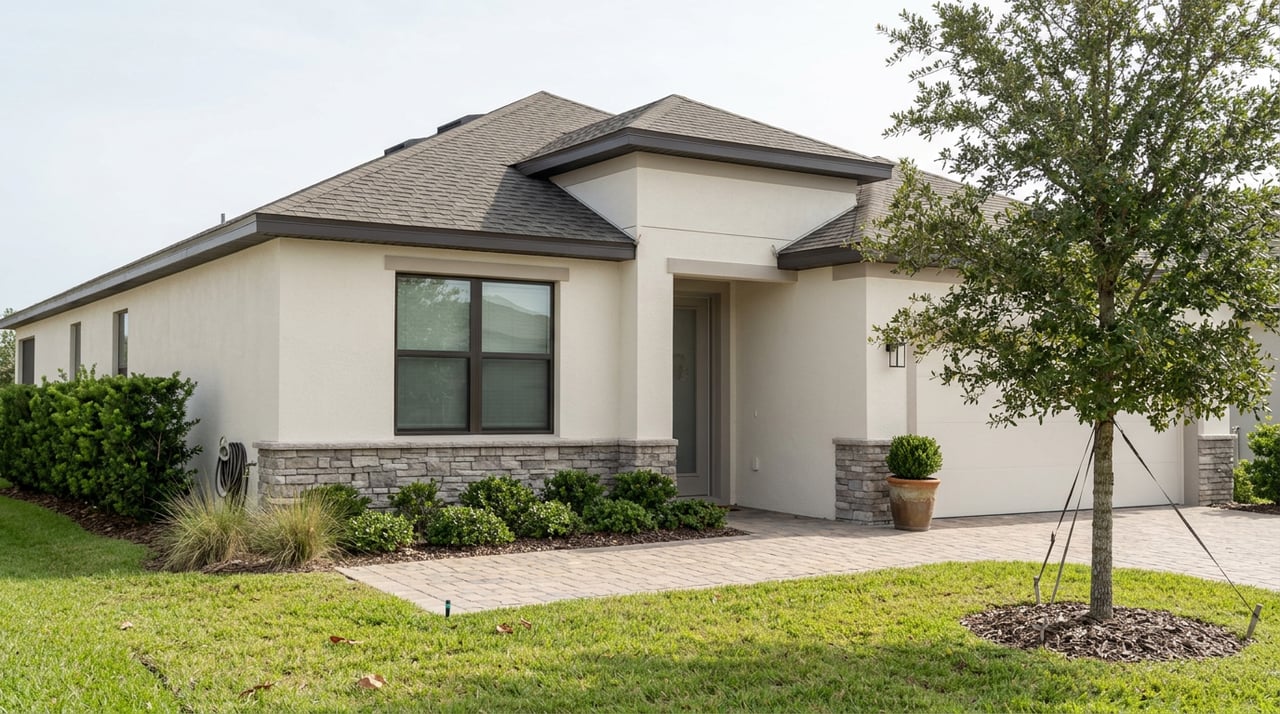
The HOA Number Isn't the Whole Story in Plant City's New Communities
August 13, 2026
August 13, 2026
A couple touring new construction in Plant City this summer might visit two model homes on the same Saturday, both a few minutes off I-4, both priced in the high $300,000s. One community advertises a homeowners association fee under $10 a month. The other lists an HOA closer to $90 a month. On paper, the first home looks like the better deal by nearly $1,000 a year.
It might not be. The community with the almost invisible HOA fee likely has something the other one doesn't: a Community Development District, or CDD, quietly collecting a separate assessment on the property tax bill that never shows up in the builder's payment estimate or the sales rep's comparison sheet.
Plant City's new-home boom sits mostly north of I-4, and several communities compete for the same buyer in roughly the same price band. North Park Isle, built out by D.R. Horton, Lennar, and Centex, anchors the largest of these with a resort-style pool, a clubhouse, and a kayak launch onto the community's lakes. Homes there have listed from the low $300,000s into the mid-$400,000s, and the HOA in most D.R. Horton sections runs under $10 a month, according to the community's own published fee schedule.
Fieldstone, a gated Cardel Homes community on the north side of the city, takes the opposite structural approach. It advertises no CDD, carries an HOA closer to $1,100 a year, and skips the resort campus in favor of larger 50- and 60-foot homesites, green space, a playground, and a dog park. Nine floor plans run from 1,805 to 4,004 square feet.
Two homes at similar price points, two very different monthly obligations once the full tax bill arrives. The HOA fee alone tells you almost nothing about which one actually costs more to own.
A Community Development District is a special-purpose local government created under Chapter 190 of the Florida Statutes. Developers use it to finance roads, drainage, utilities, and amenities by issuing bonds, then repay those bonds through an annual assessment levied on every property inside the district. The North Park Isle CDD was established by Ordinance 17-2018 and later expanded to add another 163 acres under Ordinance 21-2020, according to the district's audited financial statements filed with the Florida Auditor General.
That assessment has two parts. One is debt service, the repayment of the original construction bonds, which is fixed for the life of the bond term, typically 20 to 30 years. The other is operations and maintenance, which covers the ongoing cost of running the pool, the landscaping, and the amenity staff, and which the district's board can adjust every year. Property management firm FirstService Residential notes that annual CDD fees commonly run from a few hundred to several thousand dollars a year, collected directly on the county tax bill rather than through the HOA.
That is the mechanism the low HOA number is hiding. The CDD, not the association, is paying for the amenities that made the model home feel like a resort. The homeowner is still paying for it. It just shows up on a different piece of paper, once a year, alongside the property taxes.
Based on builder and community marketing currently public for Plant City, here is how several active communities describe their fee structure:
| Community | Builder | Advertised HOA | CDD status (as marketed) |
|---|---|---|---|
| North Park Isle | D.R. Horton / Lennar / Centex | Under $10/month in most sections | CDD established 2018, expanded 2020 |
| Farm at Varrea | D.R. Horton | About $30/quarter | Platted within Varrea South CDD |
| Fieldstone | Cardel Homes | About $1,100/year | No CDD advertised |
| Timber Ridge | Taylor Morrison | Not separately confirmed | Builder markets no CDD fees |
| Park East | Meritage Homes | About $8/month | Not confirmed either way |
Farm at Varrea, another D.R. Horton community off Charlie Taylor Road near Keel and Curley Winery, follows the same pattern as North Park Isle. Its plat is recorded under the Varrea South CDD, and its quarterly HOA runs about $30, an amount that would be difficult to explain if it were solely funding the community's two pools, fitness center, and walking trails.
Park East is the case worth sitting with. An $8 monthly HOA looks like the cheapest option on the table. Whether that number is cheap or simply incomplete depends entirely on whether a CDD sits underneath it, and that is not something a builder's marketing page reliably answers either way.
A low HOA fee is not proof of a low-cost community. It is a fact that only means something once you know what else is funding the amenities.
The fix is not complicated, but it does require asking a different question than most buyers start with.
None of this requires an accountant. It requires treating the CDD line the same way you would treat a second mortgage payment, because that is functionally close to what it is for the length of the bond term.
Plant City's broader resale market has been slow through the middle of 2026. Single-family homes listed for sale carried a median asking price of $389,000 in July 2026, with a median 91 days on the market and a price per square foot down roughly 2 to 3 percent from a year earlier.
North Park Isle has been moving faster than that citywide pace, with a median sale price around $358,190 over the trailing 12 months and an average time on market of roughly 41 days. That gap is worth sitting with. Buyers are not choosing North Park Isle because it is cheaper. They are choosing it because the amenities are visible on the tour and the CDD line is not visible on the sales sheet. The community that carries the long-term assessment is outselling the one that doesn't, not despite the hidden cost, but partly because it's hidden at the point where the decision gets made.
That is not a reason to avoid CDD communities. The infrastructure and amenities they fund are real, and plenty of buyers are happy to trade a fixed 20-to-30-year assessment for a resort pool and a kayak launch. It is a reason to make sure the tradeoff is one you're choosing on purpose, with the real number in front of you, rather than one you discover on your first November tax bill.
Does a CDD fee ever go away? The debt service portion is fixed for the bond term, generally 20 to 30 years, and disappears once the bonds are paid off. The operations and maintenance portion does not go away as long as the community's amenities are being maintained, since it funds landscaping, utilities, and staffing on an ongoing basis.
Is the CDD assessment tax deductible? It is generally treated as a non-ad valorem assessment rather than an ad valorem property tax, which affects its deductibility differently than standard property taxes. Confirm your specific situation with a tax professional or CPA before assuming either way.
Can I find out if a specific home's CDD bond has already been paid off? Yes. This is usually available through the district's own published budget documents or by requesting a current assessment breakdown from the district's management company, which will show whether the debt service portion has been reduced or eliminated.
If you're comparing new construction in Plant City and want the real monthly number before you fall for the amenity tour, Palm & Pine Realty Group can pull the CDD and tax history on any community you're considering. Let's Connect.
Stay up to date on the latest real estate trends.

I provide strategic assistance with pricing analysis, offer preparation, contract drafting, and negotiation ensuring every decision is informed and advantageous. Let’s begin the conversation.
Get In Touch With Palm & Pine Realty Group To Learn More
PALM & PINE REALTY GROUP
(813) 478-3180
[email protected]
Office - [email protected]
Sellers - [email protected]
Buyers - [email protected]
CENTRAL & NORTH CENTRAL FLORIDA