Crystal River, Homosassa, and Dunnellon Aren't Selling the Same Water
August 27, 2026
August 27, 2026
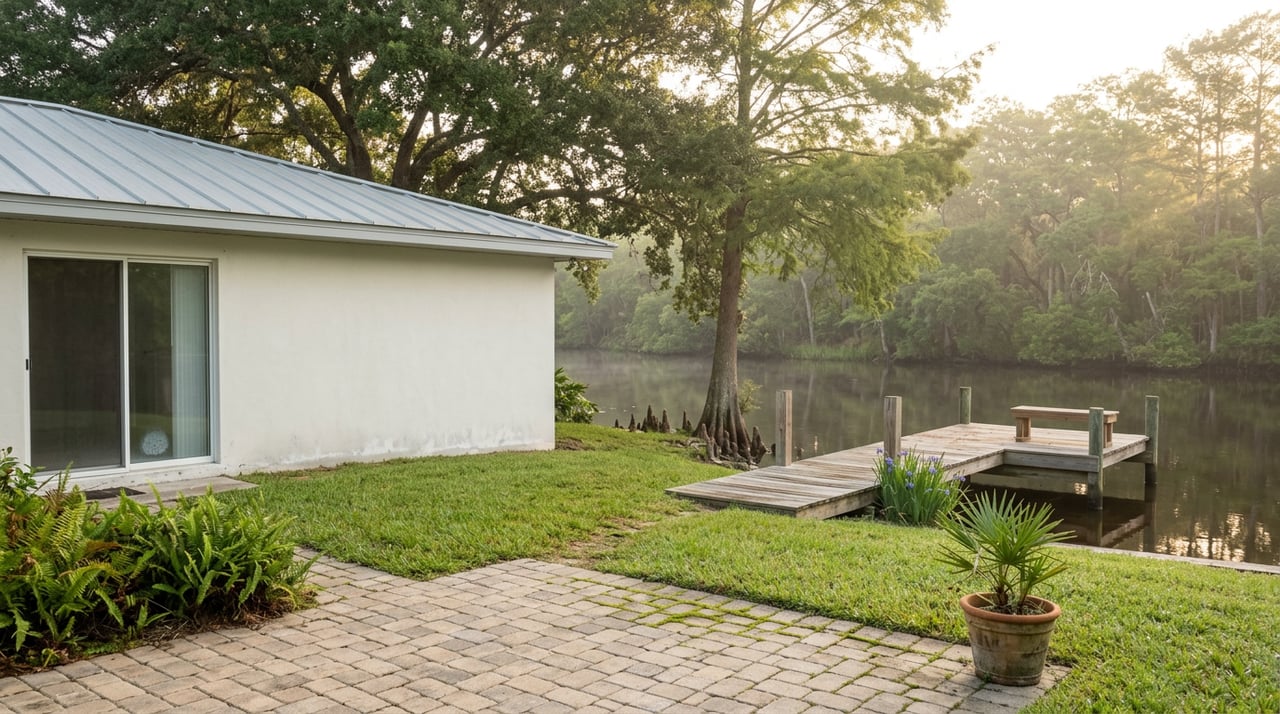
A buyer scrolling Nature Coast listings this summer sees two houses roughly a half hour apart. One sits on a canal in Crystal River with quick Gulf access, priced in the high $300s. The other sits on a river in Dunnellon, similar square footage, similar age, priced closer to $280,000. The easy read is that Crystal River is simply the nicer town. That read misses the actual mechanism. These two houses aren't competing for the same buyer because they aren't sitting on the same kind of water. One is on a spring-fed estuary that empties into the Gulf of Mexico. The other is on a freshwater river that never touches saltwater at all. The price gap has less to do with prestige and more to do with what FEMA calls each parcel, what an insurer quotes each parcel, and what rules govern a boat on each stretch of water.
That distinction matters more than the median price on any single listing, because "waterfront" on the Nature Coast is not one product. It's at least three, and they don't price the same way.
Start with Crystal River itself, because the town's own numbers make the point before you even leave city limits. Across all home types, Crystal River's citywide median listing price sat at $302,000 in August 2026, down 12 percent from the same month a year earlier. That's a softening general market. But look at waterfront listings specifically and the picture flips: active waterfront homes carried a median listing price of $399,000 as of a June 2026 MLS snapshot, with a median 112 days on market across 161 listings. The waterfront segment is running roughly a third higher than the town's own general median, even as the town's overall prices were falling.
That gap is the first clue that "Crystal River" as a search term hides two different markets. One is inland and general. The other is a narrower band of canal and bayfront parcels tied to Kings Bay, a spring-fed estuary that connects to the Crystal River channel and out to the Gulf. Kings Bay is also a nationally recognized manatee habitat, which means the water isn't just scenic, it's regulated. Speed zones and seasonal closures near springs such as Three Sisters Springs and Hunter Springs are enforced by the Florida Fish and Wildlife Conservation Commission, and dock or seawall work in the bay typically requires review from the state Department of Environmental Protection and the Army Corps of Engineers. None of that shows up in a listing photo. All of it shows up in your closing costs and your future maintenance budget.
Dunnellon tells a smaller version of the same story. General home values there run in the high $260,000s to high $270,000s on current neighborhood data, but its own waterfront segment, 33 active listings as of this summer, carries a median of $337,000 with a 105-day median time on market. The waterfront premium exists here too. It's just a narrower gap than Crystal River's, and the reason has to do with which water Dunnellon is selling.
Dunnellon sits at the confluence of two rivers with almost opposite personalities, and the distance between them can be a few hundred yards.
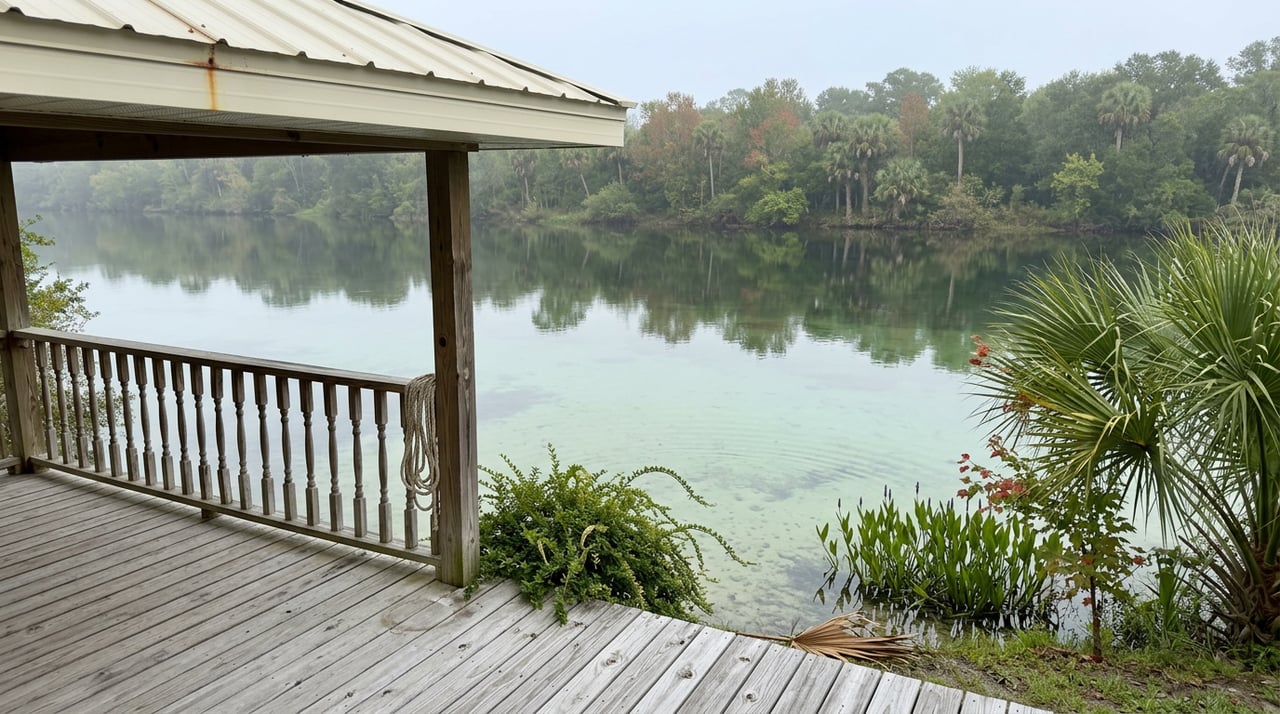
The Rainbow River is spring-fed, holds a constant 72 degrees year-round, and runs clear enough to see the bottom in most stretches. It's also treated by local buyers guides as a protected waterway, the kind where FEMA mapping and dock permitting get extra scrutiny before you can add or change a structure on the bank. KP Hole Park sits along the river and marks one of its most sought-after stretches, and Rainbow Springs State Park anchors the headwaters. This is a river built for paddling, swimming, and slow mornings more than for running a center console out to open water.
The Withlacoochee River, by contrast, is deeper and darker, tannin-stained rather than spring-clear, and genuinely suited to motorized boats. It connects downstream to Lake Rousseau and eventually toward the Gulf, and a 76-mile designated paddling trail runs the river from Lacoochee to Dunnellon for those who want the slower version. A home on the Withlacoochee side of that confluence is buying a different lifestyle and a different insurance conversation than a home a few hundred yards away on the Rainbow.
Here's the part that actually matters for a purchase decision: because both are freshwater and neither is a coastal estuary in the FEMA sense, Dunnellon waterfront properties often sit outside the higher-risk flood zones that drive up premiums on Crystal River's brackish canals. That's a meaningful reason the town's waterfront premium runs smaller in dollar terms even though the rivers themselves are arguably more scenic. You're paying less because you're insuring less risk, not because the water is worth less to look at.
Homosassa sits between the two models. Its waterways combine spring-fed clarity with canals that reach toward the Gulf, closer in character to Crystal River's Kings Bay than to Dunnellon's rivers, but without quite the same concentration of brackish, tidal-influenced canal frontage. General home values there run higher than Dunnellon's, in the low-to-mid $300,000s on current neighborhood data, reflecting a hybrid position: more Gulf-adjacent exposure than Dunnellon, but without Crystal River's downtown density of high-end bayfront addresses. If you're comparing all three towns on median price alone, Homosassa looks like a middle option. It's actually a different combination of the same two variables: water clarity and Gulf proximity, mixed in different proportions than either neighbor.
The clearest way to see the mechanism is insurance, because it's the line item that turns a scenic difference into a dollar difference.
Citrus County's average Citizens Property Insurance premium, Florida's state-backed insurer of last resort, ran about $1,410 a year as of August 1, 2026. That's a countywide floor across all property types, not a waterfront number. Layer in flood coverage and the picture changes again: a spring 2026 analysis put the average National Flood Insurance Program policy in Florida at about $938 a year, but that average blends everything from inland X-zone homes that don't need it to coastal AE and VE zone properties that pay far more.
A canal home on Kings Bay in a mapped Special Flood Hazard Area is very likely paying above both of those floors, for homeowners coverage and flood coverage combined. A freshwater canal home on the Withlacoochee side of Dunnellon, sitting outside a mapped flood zone, may be paying close to the countywide floor and skipping the flood policy requirement altogether. Same region, same rough price bracket in some cases, very different carrying cost once you're past the mortgage payment.
If you're comparing Nature Coast waterfront across these towns, the question that actually protects you isn't "what's the waterfront premium." It's a shorter list, asked in this order:
None of these questions show up in a listing description. All of them show up in your first year of ownership.
Does Dunnellon have any saltwater or Gulf-direct waterfront? Not directly. Its two rivers are freshwater, with the Withlacoochee eventually reaching toward the Gulf through Lake Rousseau, but Dunnellon itself sits inland of the true estuary systems that Crystal River and Homosassa front.
Is Crystal River's waterfront premium worth it if I don't boat? That depends on what you're actually paying for. If the draw is walkability to downtown, springs viewing, and Kings Bay itself rather than deep-water boat access, a near-water or canal-front position may deliver the lifestyle at a lower insurance cost than an outer-channel address built for offshore runs.
Do manatee protection rules affect resale value? They affect use more than they affect price directly, but they're worth disclosing early to any buyer who plans to boat regularly, since seasonal speed zones and dock permitting timelines shape how the property actually functions for its owner.
A median price tells you almost nothing about which of these three markets you're standing in. The water does. If you're weighing Crystal River, Homosassa, or Dunnellon and want someone to walk the actual parcel-level questions with you before you write an offer, Palm & Pine Realty Group is a good place to start that conversation.
Stay up to date on the latest real estate trends.
I provide strategic assistance with pricing analysis, offer preparation, contract drafting, and negotiation ensuring every decision is informed and advantageous. Let’s begin the conversation.
Get In Touch With Palm & Pine Realty Group To Learn More
PALM & PINE REALTY GROUP
(813) 478-3180
[email protected]
Office - [email protected]
Sellers - [email protected]
Buyers - [email protected]
CENTRAL & NORTH CENTRAL FLORIDA